Latest post
 Oct 9, 2026, 00:29:58
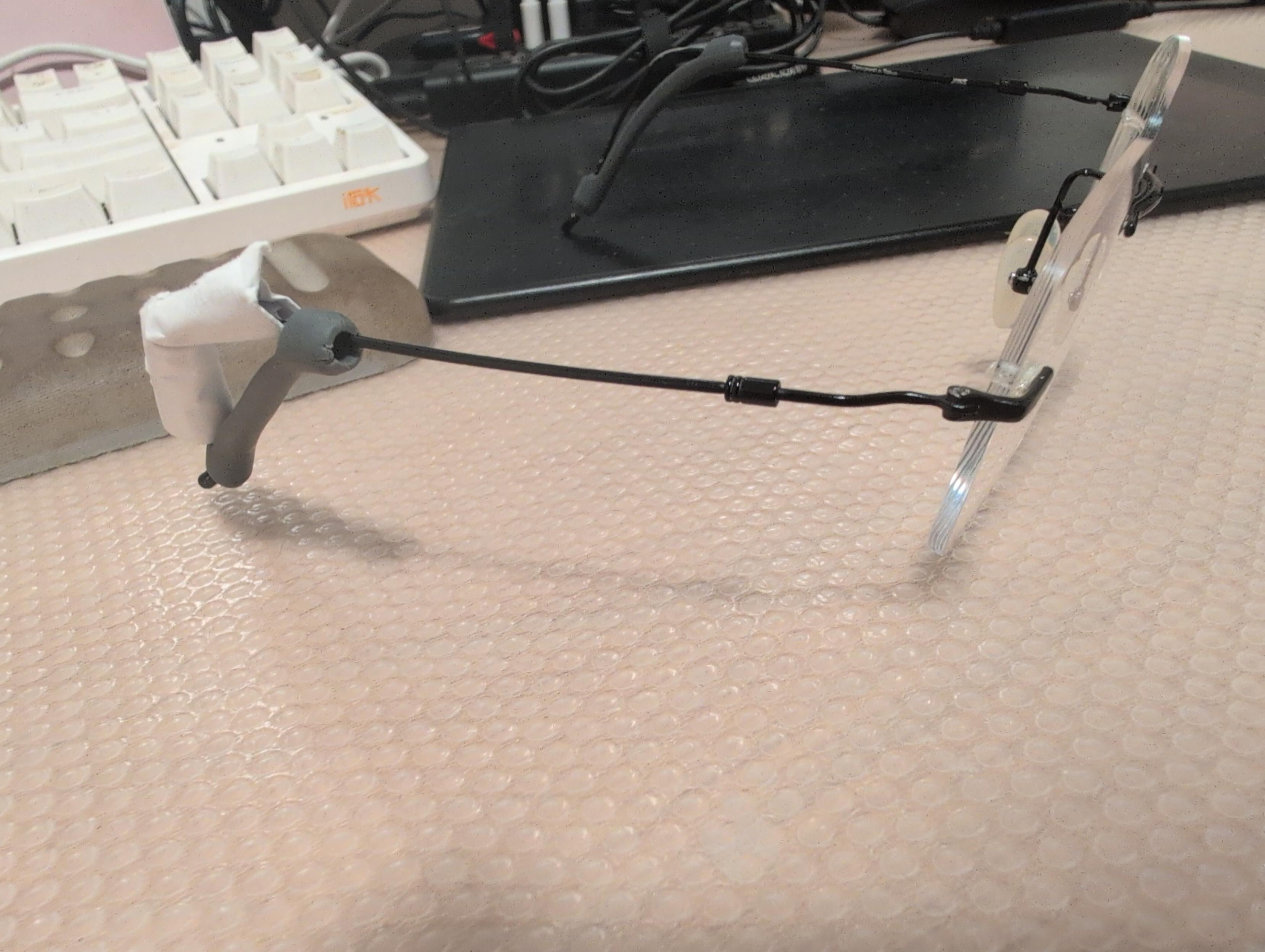
One leg of my glasses fell of. After I glue it back, the legs become unbalanced. However, I cleverly fixed it by using a piece of paper to compensate for the leg height difference.
follow me on Mastodon
Articles
-
Monkey-patching graciously
 Monkey-patching is a powerful tool in programming. In this article, I used techniques of Ruby metaprogramming to define a series of methods
 def_after,def_before, etc. to help monkey-patching. They look graciously in that we can use it to shorten the codes for monkey-patching (avoiding aliasing and repeating codes). -
Amazing Siteleaf
 I have been using Siteleaf to manage my blog. It is just convenient and amazing.
 -
Hyperellipsoids in barycentric coordinates
 In this article, I introduce the barycentric coordinates: it is an elegant way to represent geometric shapes related to a simplex. By using it, given a simplex, we can construct a hyperellipsoid with the properties: its surface passes every vertex of the simplex, and its tangent hyperplane at each vertex is parallel to the hyperplane containing all other vertices.
 -
Use complex numbers as canonical variables
 In this article, I try exploring an idea: using complex numbers to combine pairs of canonical variables into complex variables: . It turns out that we can write canonical equations , Poisson brackets
, and canonical transformations
in these complex numbers. Finally, I show two examples of using them in real problems: a free particle, and a harmonic oscillator.
In this article, I try exploring an idea: using complex numbers to combine pairs of canonical variables into complex variables: . It turns out that we can write canonical equations , Poisson brackets
, and canonical transformations
in these complex numbers. Finally, I show two examples of using them in real problems: a free particle, and a harmonic oscillator. -
Giving birth to my own blog
 This is my first blog! I will share interesting things in my life here.
subscribe via Atom