Latest post
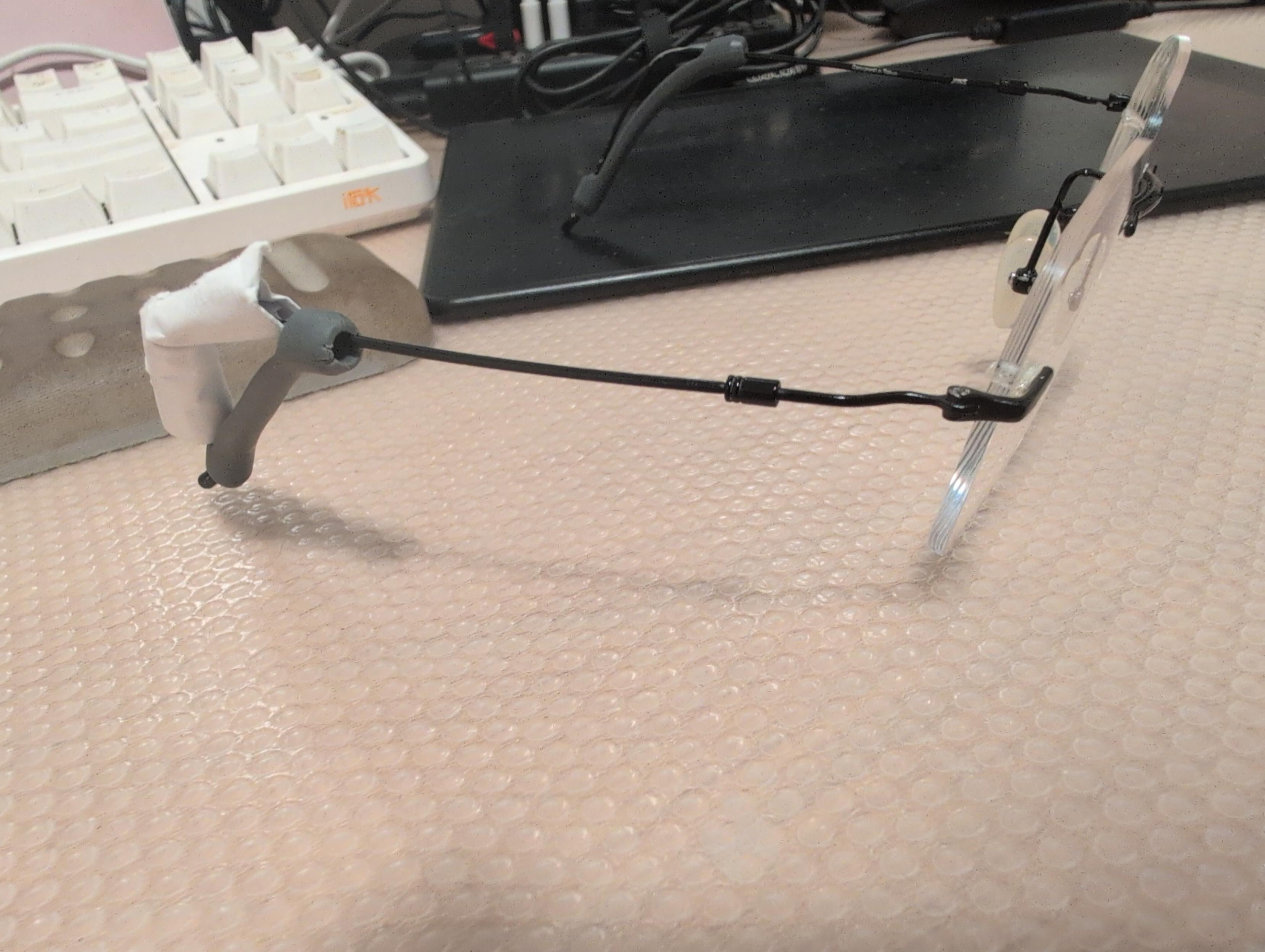 Oct 9, 2026, 00:29:58
One leg of my glasses fell of. After I glue it back, the legs become unbalanced. However, I cleverly fixed it by using a piece of paper to compensate for the leg height difference.
follow me on Mastodon
Articles
-
Simulating a mechanical system using RGSS3
 Hamiltonian mechanics gives us a good way to simulate mechanical systems as long as we can get its Hamiltonian and its initial conditions. I implemented this simulation in RGSS3, the game scripting system shipped with RPG Maker VX Ace.
 -
Writing a DSL with commands split by space
 DSL means domain-specific language. Ruby is a powerful script language in terms of building DSLs (as sublanguages of Ruby). In this article, I implemented my idea of a DSL with commands split by space. For example, you may just write
 a b cto run the commandsa,b, andcone after another! This trick is heavily applied in my project alda-rb. How do I achieve this? -
Running Jekyll myself
 I have got tired of letting GitHub Pages to run Jekyll for me. I cannot use custom plugins! I decide to run Jekyll myself and push the built result to GitHub repo. I wrote a script to do this.
 -
Algebraic structure of chemicals
 Regarding balancing chemical equations, actually we are trying to find a non-trivial linear combination of some chemicals to get zero. The interesting thing is that the coefficients can only be integers (), which is not a field, so the algebraic structure of chemicals is not linear space. They actually live in a free -module. See how I formalize this idea in mathematical language.
 -
The concentration change of gas in reversible reactions
 A reversible elementary reaction takes place inside a closed, highly thermally conductive container of constant volume, whose reactants are all gases. Given the reaction equations and the reaction rate constants, a natural question to ask is how the concentration of each gas changes w.r.t. time. In this article, I will answer this question by proposing a general approach to solve it.
 -
Snippet: O, ’tis too true!
 O, ’tis too true!
 -
The structure of a basic RM game
 In this article, I present minimal examples of a RM game. They only illustrate the basic concepts of how a RM game is structured and what is the running logic of it.
 -
The frequency assignment of musical notes
 This article explores the concept which I call the frequency assignment, which is a mapping from (the set of notes) to (the set of frequencies). Concepts such as octaves, intervals, and equal temperaments are introduced.
 -
Normal vectors of a scalar field
 This article gives the formula for the normal vectors of a surface defined by a scalar field on . The normal vector of the graph of the function at is . This also provides us a way to recover a scalar field from the normal vectors of its graph: normalizing the vectors so that the last component is , and then integrate the rest components.
 -
It is Feb 29 today!
 It is Feb 29 today. The date appears once for as long as 4 years!
subscribe via Atom