Analyzing the narrative of Kittens Game
About this post
- Title
- Analyzing the narrative of Kittens Game
- Permalink
- https://ulysseszh.github.io/literature/2026/06/25/kittens-analysis.html
- Author
- UlyssesZhan <ulysseszhan@gmail.com>
- Date
- 2026-06-25T22:11:44+0800
- Categories
- literature
- Tags
- review
- Abstract
- Kittens Game is an incremental game that has very few narrative sentences presented in the game. However, it tells a very rich story in its own unique way through the interaction with the player.
- Cover
-
 (prompts)
- License
- CC-BY-4.0
- View source
- View history
- Comment
Table of contents
This article is adapted from my submission to a writing class assignment at school.
This analysis centers about a game called Kittens Game.
Calling Kittens Game a video game is a bit of a far stretch in that it is a text-based game, where the only visual feedback is textual instead of having visual images. Furthermore, even though it is text-based, there is not a single line of narrative in the game. All the texts are just statistical numbers, names and descriptions of events and upgrades, and other miscellaneous texts such as the game settings. However, the story it tells is extremely content-rich. I am not going to insert screenshots of the game in the middle of this analysis because screenshots would be the least interesting thing in this analysis before I explain the story. A screenshot or a short video of the gameplay does not tell anything about the rhetorics of the game, but the player can only feel the progression in story by unlocking game mechanics through weeks or even years of gameplay. Rather, I will include some flowcharts of the upgrades that the player can unlock throughout the game. In the end of the analysis, I will include a few screenshots and leave some remarks on them.
For its genre, Kittens Game is an incremental game. Like any incremental games, the main game mechanics is to do repetitive actions or buy automations to accumulate in-game resources. Incremental games can usually be categorized into clicker games and idle games, determined by whether repetitive actions or automation upgrades are more central to the gameplay. Kittens Game is neither. It is not a clicker game because repetitive clicking can produce meaningful amounts of resources only during the first ten minutes of gameplay, which is a very small portion of the full gameplay compared with the months a player has to spend before unlocking the late-game mechanics. It is not an idle game because resources max out so quickly that almost all resource incomes are obtained during active playing. Requiring the player’s active non-repetitive attendance makes the game extraordinarily engaging compared with other incremental games. This gameplay style makes the player experience the progression in the game very attentively.
However, the player does not immediately get to know what the game tries to tell the player through the attentive experience of the progressions in numbers. At first, the upgrades and buildings in the game just feel like any other game with resources and buildings: there are different kinds of buildings, such as Huts for population, Warehouses for storage, Lumbermills for production, and Academies for development; there are different kinds of jobs, such as Farmers, Miners, Hunters, and Scholars; there are different upgrades, whether scientific or political, with different consequences, such as Clear Cutting vs. Strip Mining vs. Environmentalism, Monarchy vs. Autocracy vs. Republic, etc. The game even feels cute in that the population are kittens instead of humans. The player gets to make a lot of choices, such as different assignment of jobs for the kittens and different priorities in purchasing upgrades, but the choices feel purely strategic rather than having rhetorical meanings.
The turning point is when kittens discover Zebras and start trading with them. There are races that the player gets to trade with before Zebras appear, but what is different is that Zebras are especially hostile towards kittens while being the sole source of getting a crucial resource at this stage: titanium. At this point, the player realizes that diplomacy is mostly just about managing hostility, revealing the cruelty of the political world of the game: it is a Hobbesian world of bellum omnium contra omnes (the war of all against all). It is then interesting to think about why the author chose “Zebras” out of all possible names of such a race. This choice of author is not random but a reference to the books The Exegesis of Philip K. Dick (abbreviated as Exegesis) and VALIS (acronym for Vast Active Living Intelligence System) by Philip K. Dick (abbreviated as PKD). PKD explores the idea of gnosticism in those books: the material world is inherently flawed or illusory, referred to as the Black Iron Prison (abbreviated as BIP), created by a lower, often malevolent, deity, referred to as the Demiurge. For PKD, the world we inhabit may be a simulation or illusion, controlled by an external or higher force, the true god. “Zebra” is a name for gnostic gods, a divine, camouflaged intelligence that mimics the environment to communicate with humans. They are not the Demiurge but is the true god, who lives in a higher dimension over the material simulation world; their goal is to wake up mortal people in the BIP, which is the reason why Zebras in Kittens Game act as the external force to provide titanium, the very material needed to build ships and leave the planet. PKD’s visions of the BIP refer to a world of oppression and confinement, which resonates with the gnostic idea of the material world as a prison for the soul.
Speaking of leaving the planet, let us come back to the technological advancement of kittens. As we mentioned, science and technology start as being utilitarianistic, consisting of mostly agricultrue, mining, and construction. However, the story shifts drastically as the player advances to unlocking Rocketry. The story shifts from kittens on a farm to kittens as a galactic force. Science tells the kittens that their home planet is finite and insufficient, but they have to leave the planet to gain more space and more energy. From this point, the focus of the gameplay shifts from constructing earth-based buildings to constructing space-based buildings: there are space-based population buildings such as Space Stations and space-based resource production buildings such as Hydraulic Fracturers. In the next stage, the player gets to unlock more sciences that do not sound like physics at all, but the kittens are using technology to mold the reality itself. For example, Quantum Cryptography signifies the realization that the universe is made of information instead of just matter, and kittens start hacking their way out of reality; Chronophysics signifies the realization that time is but a variable that can be manipulated, and kittens step outside of the linear flow of the game to gain resources from the future. This process is not the normal kind of technological development at all, but the process of breaking out of the BIP.
I have been talking about kittens for a while, but what does this have to do with the player, the one who actually makes the choices that lead all the things to happen to kittens? This leads to the ultimate philosophical question in the game: who is the player? To answer this question, I will introduce another concept in the game: resetting. It is actually a common game mechanics called “prestige” shared by many incremental games, which typically clears the current progress in exchange for permanent upgrades. It mainly serves as a strategic move that players can choose to take to accelerate future advancement. In Kittens Game, the player gains Karma and Paragon by resetting, which are resources that persist through resetting. In order to advance at a reasonable rate, the player has to reset once in a while. This is just like the myth of Sisyphus: the player pushes the boulder up the hill (build the kittens civilization) and then intentionally roll it back down (reset for Paragon). Then, what does the kittens’ lives mean if they are destined to be erased? The game suggests that the only meaning is the accumulation of gnosis, symbolized as Karma and Paragon. What does it mean for the player if the game is just an endless cycle of resetting? The game forces the player to answer the same question posed to Sisyphus every time the player chooses to click the “reset” button. The answer suggested by the game is that the player is playing the role of the Demiurge. The player, or the Demiurge, creates this world in which kittens live, traps the kittens in a loop and forces them to labor for their own amusement (seeing the statistical numbers going up). From this point of view, this game that looks cute from far actually tells a tragic story, where the kittens use their accumulated gnosis through the endless destructions of the world in order to escape the BIP created by the Demiurge, yet they are still under the control of the Demiurge after countless trials, merely serving as the source of amusement for the Demiurge.
All of these are just a small part of the game. Every one of the game mechanics tells a part of the story. For example, the Order of the Sun religion in the game can be viewed through a gnostic lens as the worship of the Demiurge, and the kittens later find out that the traditional “worship” is just another layer of the prison to be exploited for higher understanding. The Leviathans, another race with which kittens can trade that appear after Zebras, is a reference to Thomas Hobbes’ book Leviathan or The Matter, Forme and Power of a Commonwealth Ecclesiasticall and Civil, and they act as the wardens of the BIP by providing Relics as part of the prison to prevent the bellum omnium contra omnes. The Void, a late-game resource gained from Temporal Paradoxes, signifies kittens’ use of the nothingness of the BIP to power their escape. Literally every mid-game and late-game mechanics can be expanded in long paragraphs on how it contribute to what the game wants to tell the player.
The fact that the game is able to tell the player so rich a story without a single line of narrative is what this game is amazing at and what makes this game stand out among all incremental games. Instead of directly telling the player the story, it urges the player to think and construct the story on their own every time the player makes a choice, clicks a button, and receive a feedback. This form of story-telling is unique to interactive digital media, and Kittens Game pushes it to its limit in utilizing this way to tell the full picture of an extremely rich story.
Now it is time to look back on the visual interface of the game.
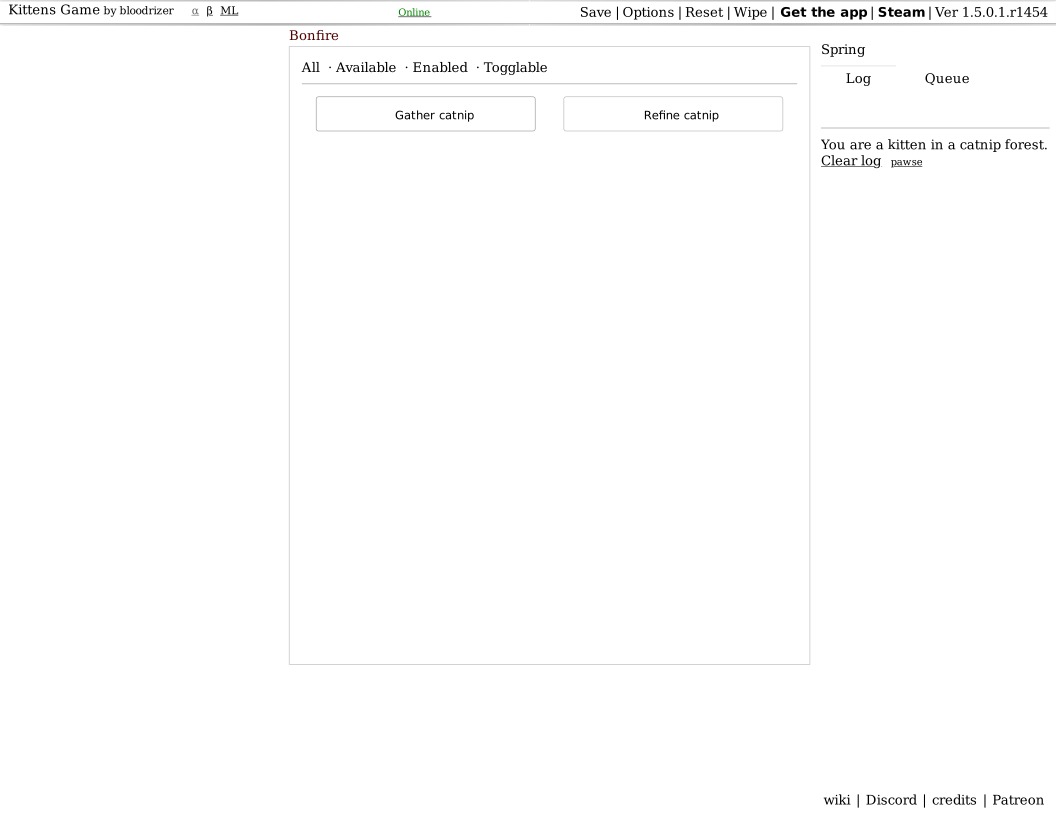
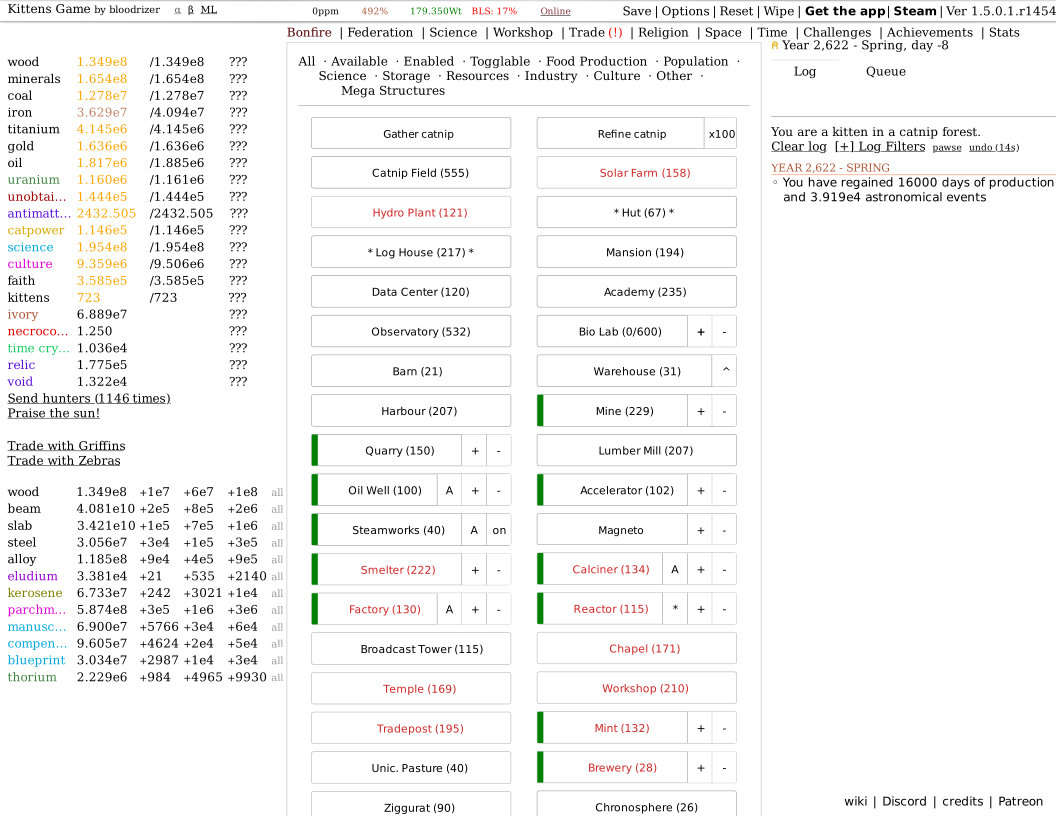
As can be seen, this is an extremely plain game interface, which is indeed the least interesting thing about the game at first glance. However, as the player connects the game with the BIP, the asthetic choice of this game interface suddenly makes sense: the interface itself depicts a literal BIP, where everything is just plainly laid out without deep thoughts and freedom. Seeking amusement from such a lifeless-looking thing, is not the player themself looking like something under the control of the Demiurge? Through the interface design, the game breaks the fourth wall to tell its deep philosophical and religional message to the player in the most subtle way.